⚙️
We’re currently fine-tuning a few things behind the scenes at Stratford Academy. Some features may be temporarily unavailable, but our team is working hard to make everything run perfectly again.

Shopping Cart

Your cart is empty

Add a course to start building your cart.

Total Items: 0
Total Price: 0
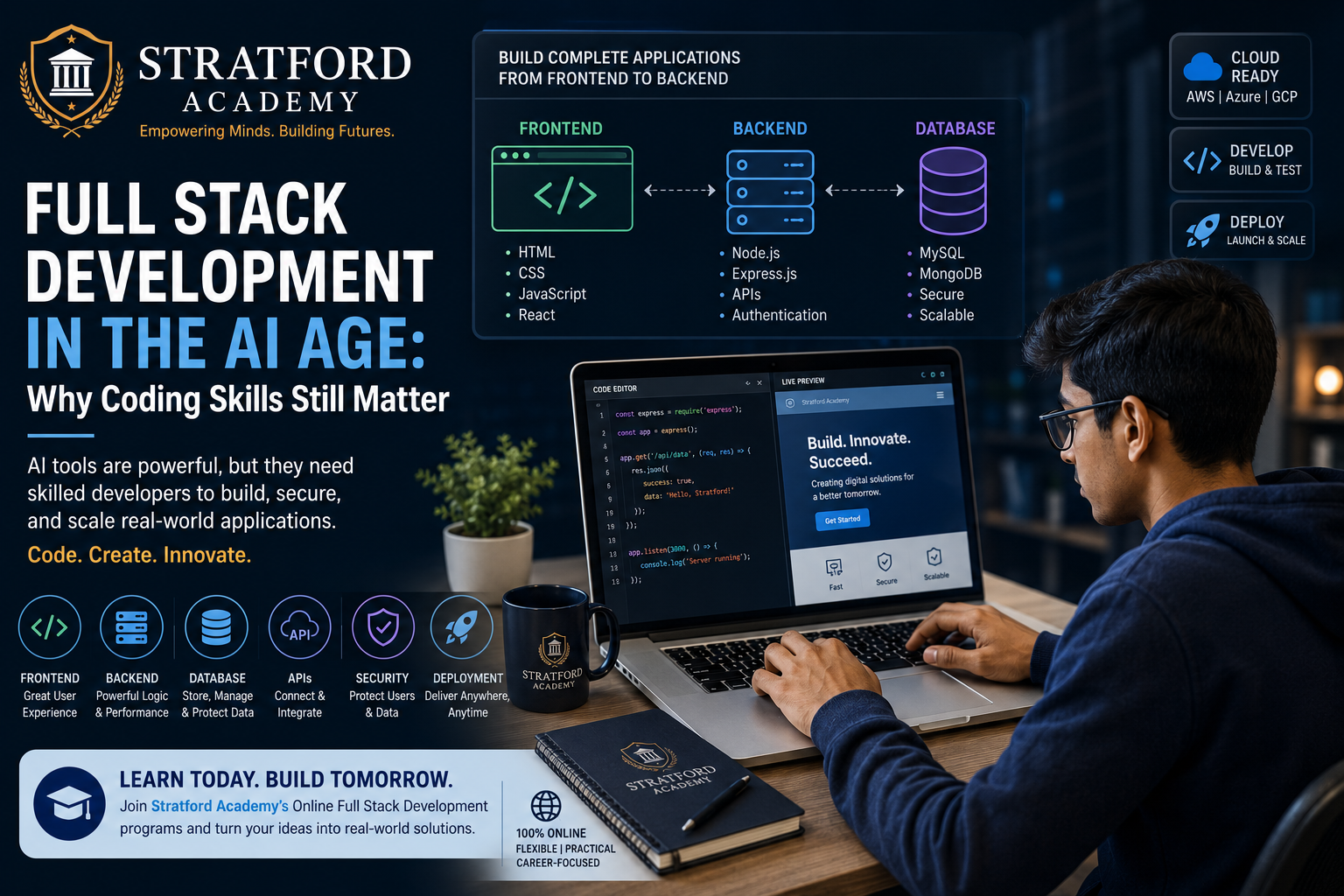
Full Stack Development in the AI Age: Why Coding Skills Still Matter

Full Stack Development in the AI Age: Why Coding Skills Still Matter


Full Stack Development in the AI Age: Why Coding Skills Still Matter

Artificial Intelligence is changing the way people work, learn, and build technology. AI tools can now help write code, detect errors, generate ideas, create designs, and automate repetitive tasks. Because of this, many students ask an important question: Do coding skills still matter in the AI age?

The answer is yes.

Coding skills are still highly valuable because AI tools can support development, but they cannot replace the need for strong technical understanding, problem-solving ability, and human decision-making. Businesses still need professionals who can design, build, test, improve, and maintain reliable digital products.

At Stratford Academy, we believe full stack development remains one of the most practical and future-ready skills for students who want to enter the technology field.

What Is Full Stack Development?

Full stack development refers to the ability to work on both the front end and back end of a digital application.

The front end is the part users see and interact with, such as websites, dashboards, forms, buttons, menus, and mobile-friendly interfaces.

The back end is the part that works behind the scenes. It includes servers, databases, APIs, authentication, security, and business logic.

A full stack developer understands how both sides work together to create complete digital solutions.

Why Full Stack Development Is Still Important

Every modern business needs digital platforms. Companies use websites, apps, dashboards, learning portals, payment systems, CRM tools, booking platforms, and internal software to operate efficiently.

Full stack developers help build these systems from concept to launch. They understand how to turn an idea into a working product.

Even when AI tools assist with coding, developers are still needed to:

  • Understand project requirements
  • Design user-friendly experiences
  • Build secure and scalable applications
  • Connect databases and APIs
  • Test and fix technical issues
  • Improve performance
  • Maintain long-term software quality

AI can generate code, but humans must understand whether that code is correct, secure, efficient, and suitable for real users.

How AI Is Changing Software Development

AI is becoming a powerful assistant for developers. It can help students and professionals write code faster, explain complex concepts, suggest improvements, and reduce repetitive work.

However, AI does not remove the need to learn programming. In fact, it makes technical knowledge even more important. A student who understands coding can use AI more effectively than someone who simply copies AI-generated answers without knowing how they work.

To succeed in the AI age, students should learn how to combine coding knowledge with AI-assisted development. This means using AI as a support tool, not as a replacement for learning.

Key Skills Students Should Learn

Full stack development requires a strong combination of technical and practical skills.

1. HTML, CSS, and JavaScript

These are the foundation of web development. HTML structures the page, CSS controls design and layout, and JavaScript adds interactivity.

Students who learn these basics can understand how websites are built and how users interact with digital platforms.

2. Frontend Frameworks

Modern websites often use frameworks and libraries that help developers build faster and more organized applications. These tools support reusable components, better performance, and improved user experience.

Frontend skills help students create professional, responsive, and user-friendly interfaces.

3. Backend Development

Backend development focuses on server-side logic, databases, authentication, APIs, and application workflows.

Students should understand how data is stored, processed, protected, and delivered to users through secure systems.

4. Databases

Most applications need to store and manage information. Databases help organize user accounts, payments, course records, product details, messages, and business data.

Learning databases helps students understand how real applications manage information behind the scenes.

5. APIs and Integration

APIs allow different systems to communicate with each other. For example, a website may connect with a payment gateway, email service, CRM system, or AI tool through an API.

API knowledge is essential for building modern digital products.

6. Version Control and Deployment

Students should also learn how to manage code, collaborate with teams, and deploy applications online. These skills prepare learners for real technology work environments.

Career Opportunities in Full Stack Development

Full stack development can support many career paths in technology. Students may explore roles such as:

  • Full Stack Developer
  • Frontend Developer
  • Backend Developer
  • Web Developer
  • Software Developer
  • Application Developer
  • Junior Software Engineer
  • API Developer
  • Technical Support Developer
  • Product Development Associate

These roles are valuable across industries because almost every organization now depends on digital products and online systems.

Why Full Stack Skills Connect With Other Technologies

Full stack development also connects strongly with other high-demand fields.

In Artificial Intelligence, developers build interfaces and applications that allow users to interact with AI systems.
In Data Science, developers create dashboards and platforms to display insights.
In Cybersecurity, developers must build secure applications and protect user data.
In Cloud and DevOps, developers deploy, monitor, and scale applications online.

This makes full stack development a powerful foundation for students who want flexibility in their technology careers.

Why Online Learning Works for Coding

Online learning is a strong pathway for full stack development because students can learn concepts, practice coding, complete projects, and build applications from anywhere.

At Stratford Academy, our online-first education model is designed to help students gain practical knowledge in modern technology fields. Our programs support learners who want to build career-focused skills in areas such as:

  • Full Stack Development
  • Artificial Intelligence
  • Data Science
  • Cybersecurity
  • Cloud Computing
  • DevOps
  • Digital Business Technologies

Our focus is to help learners build confidence through structured, practical, and accessible online education.

The Future of Coding

The future of coding will not be about memorizing every command. It will be about understanding systems, solving problems, using tools wisely, and building products that people can actually use.

AI will continue to improve, but skilled developers will still be needed to guide technology, review outputs, make decisions, and create reliable digital solutions.

Students who learn full stack development today will be better prepared to work with AI, not against it.

Stratford Academy’s Commitment

Stratford Academy is committed to helping students prepare for the future of work through flexible, online, and career-aligned education. As technology continues to evolve, we aim to support learners with practical programs that build relevant skills for the digital economy.

Full stack development remains an important pathway for students who want to understand how digital products are built from start to finish.

Conclusion

Full stack development is still one of the most valuable skills in the AI age. While AI tools can make coding faster, students still need strong technical knowledge to build secure, useful, and professional applications.

By learning frontend, backend, databases, APIs, deployment, and modern development practices, students can prepare themselves for meaningful opportunities in the technology sector.

At Stratford Academy, we believe the future belongs to learners who can think critically, build confidently, and adapt to the changing world of technology.


Comments

Comments section can be added here for reader engagement.

Leave a Comment

Your email address will not be published. Required fields are marked *