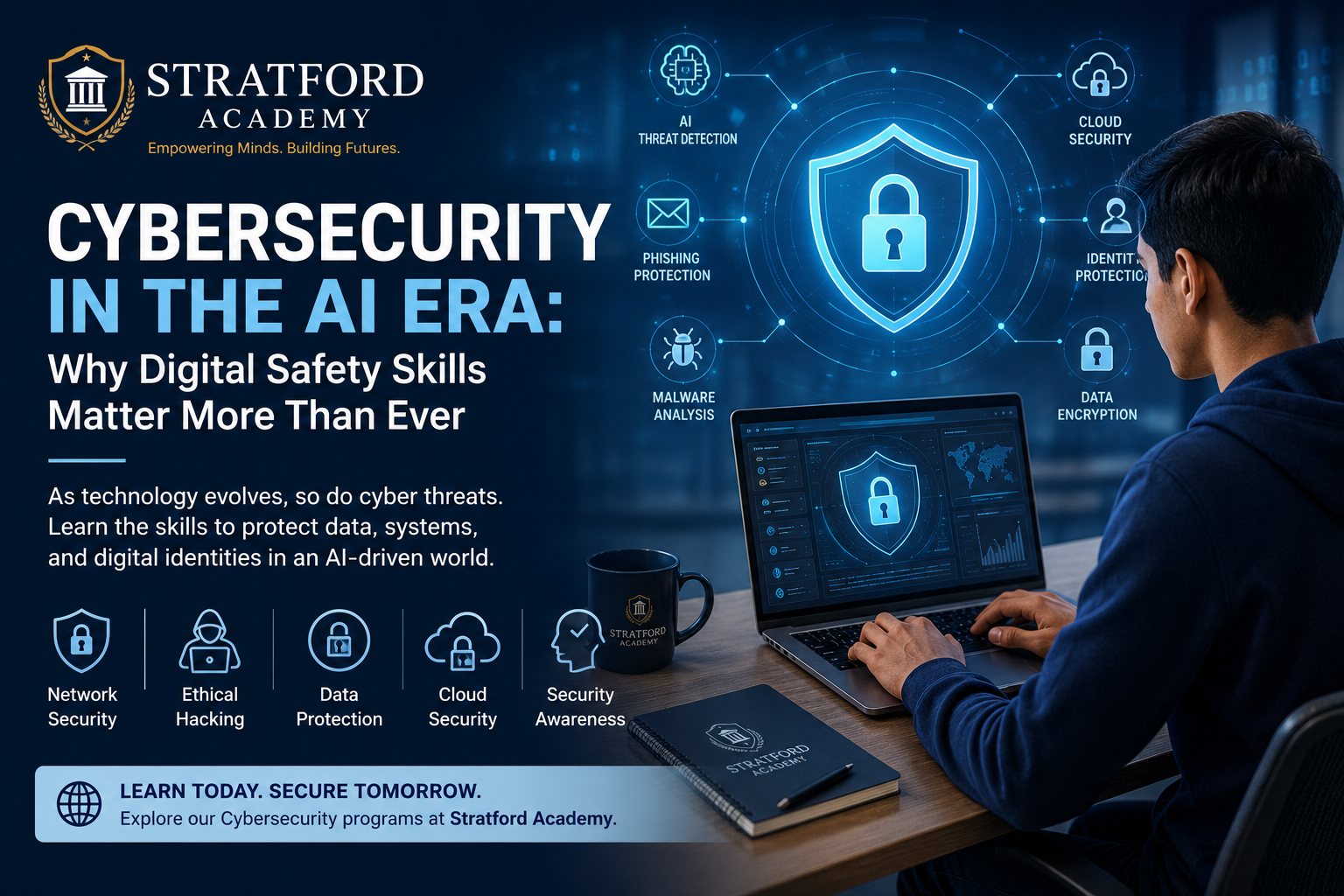
Cybersecurity in the AI Era: Why Digital Safety Skills Matter More Than Ever
As the world becomes more connected, cybersecurity has become one of the most important skills in the digital economy. Businesses, universities, hospitals, banks, government agencies, and online platforms all depend on secure systems to protect information, maintain trust, and operate safely.
At the same time, Artificial Intelligence is changing the way technology is used. AI tools are helping organizations automate tasks, analyze data, improve customer experiences, and make faster decisions. However, the growth of AI also brings new digital risks. Cyber threats are becoming more advanced, and organizations need trained professionals who can understand both technology and security.
At Stratford Academy, we believe students must be prepared for this new reality. Cybersecurity is no longer a skill only for IT teams. It is becoming a core career skill for anyone entering the modern digital workforce.
Why Cybersecurity Is More Important Today
Every online action creates data. From logging into an email account to making an online payment, using a learning platform, storing business files, or accessing cloud software, digital systems are constantly exchanging information.
This creates opportunity, but it also creates risk.
Cybercriminals may attempt to steal data, attack websites, misuse passwords, disrupt business systems, or exploit weak security practices. As more organizations move to cloud platforms and AI-powered tools, the need for strong cybersecurity knowledge continues to grow.
Cybersecurity helps protect:
- Personal information
- Business data
- Financial transactions
- Online learning platforms
- Cloud systems
- Customer records
- Digital identities
- Internal communication networks
Without proper cybersecurity practices, even a small mistake can lead to major damage.
How AI Is Changing Cybersecurity
Artificial Intelligence is now being used by both security professionals and cyber attackers. This makes cybersecurity more complex and more important.
Security teams can use AI to detect unusual activity, monitor systems, identify threats, and respond faster to risks. AI can help analyze large amounts of data and find warning signs that humans may miss.
However, attackers may also use AI to create more convincing phishing emails, automate attacks, generate fake content, or search for system weaknesses more quickly. This means students and professionals must learn how to use AI responsibly while also understanding how to defend against AI-powered threats.
The future of cybersecurity will require people who can combine technical knowledge with critical thinking, ethical judgment, and practical problem-solving.
Key Cybersecurity Skills Students Should Learn
To build a strong foundation in cybersecurity, students should focus on both technical and practical skills.
1. Network Security
Networks connect computers, applications, servers, and users. Learning network security helps students understand how information moves and how systems can be protected from unauthorized access.
This includes concepts such as firewalls, IP addresses, secure connections, network monitoring, and access control.
2. Ethical Hacking
Ethical hacking teaches students how security weaknesses are found before attackers can misuse them. Ethical hackers use legal and responsible methods to test systems, identify vulnerabilities, and recommend improvements.
This skill is valuable because organizations need professionals who can think like attackers but act with integrity.
3. Data Protection
Data is one of the most valuable assets in any organization. Students must understand how to protect sensitive information, manage access permissions, use encryption, and follow responsible data handling practices.
Strong data protection is especially important in industries such as education, healthcare, finance, and technology.
4. Cloud Security
Many businesses now use cloud platforms to store files, run applications, and manage operations. Cloud security helps protect these systems from unauthorized access, misconfiguration, and data exposure.
Students who understand cloud security can support organizations that rely on modern digital infrastructure.
5. Security Awareness
Not every cyber risk is highly technical. Many attacks succeed because people click unsafe links, use weak passwords, or share sensitive information without verification.
Cybersecurity education helps students develop awareness, caution, and better digital habits. These skills are useful in every career field.
Cybersecurity Career Opportunities
Cybersecurity offers a wide range of career paths. Students who build strong skills in this field can explore roles such as:
- Cybersecurity Analyst
- Security Operations Center Analyst
- Ethical Hacker
- Network Security Associate
- Cloud Security Associate
- Information Security Specialist
- Risk and Compliance Analyst
- Security Consultant
These roles are important across many industries because every organization that uses technology needs protection.
Why Online Learning Is a Strong Pathway
Online learning is one of the most effective ways to build cybersecurity skills because it allows students to learn flexibly while practicing real-world concepts. Cybersecurity is a practical field, and students benefit from structured lessons, technical exercises, case-based learning, and guided projects.
At Stratford Academy, our online-first education model is designed to help learners gain relevant knowledge in modern technology fields, including:
- Cybersecurity
- Artificial Intelligence
- Data Science
- Cloud Computing
- Full Stack Development
- Digital Business Technologies
Our programs are built to support learners who want practical, career-focused education that fits today’s digital environment.
The Human Side of Cybersecurity
Technology alone cannot solve every security problem. Human judgment is still essential.
Cybersecurity professionals must be responsible, ethical, alert, and able to communicate clearly. They must explain risks, guide teams, document incidents, and help organizations make better decisions.
This is why cybersecurity education should not only focus on tools. It should also develop discipline, responsibility, and professional decision-making.
Stratford Academy’s Commitment
Stratford Academy is committed to helping students prepare for the future of work through accessible and industry-relevant online education. As cybersecurity becomes more important in the AI era, students must be ready to protect digital systems, understand modern risks, and support safer technology use.
Our goal is to help learners build confidence, technical understanding, and practical awareness in high-demand fields that are shaping the future.
Conclusion
Cybersecurity is no longer optional. It is a necessary skill in a world where businesses, education, communication, and daily life depend on digital systems.
As AI, cloud platforms, and online services continue to grow, the demand for cybersecurity knowledge will only increase. Students who start learning cybersecurity today will be better prepared for tomorrow’s opportunities.
At Stratford Academy, we believe the future belongs to learners who are prepared, responsible, and ready to protect the digital world.

 Bookmark

Comments
Comments section can be added here for reader engagement.